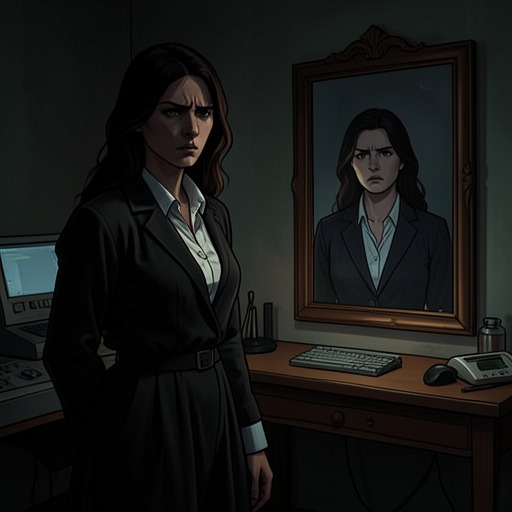
«Conflicto entre el yo real y el yo anhelado»
Los renglones torcidos de Dios«Conflicto entre el yo real y el yo anhelado» is Alice Gould’s formulation of madness as a conflict between the actual self and the self a person desires to be. Its significance lies in the contrast the surrounding discussion draws between two apparently opposite disturbances: in one, repressed tendencies surface into consciousness; in the other, the subconscious stubbornly withholds its truth. Both are presented as versions of a conflict between the true self and the false self, but they make the question of what counts as real difficult to answer.
The formulation and its terms
Alice’s formulation appears as she reflects on different forms of disturbance. The real self and the desired self are not simply two clearly identifiable personalities, one authentic and the other invented. The passage instead makes their relation a problem of access: a person may fail to recognize what is repressed, or may remain cut off from what the subconscious keeps hidden. The distinction matters because the self that is least visible to consciousness may, in either case, be the true one.
The phrase therefore gathers together two directions of conflict rather than describing one uniform symptom. A truth may break through into consciousness, or consciousness may be prevented from reaching a truth that remains below it. The common element is not the same outward behavior or psychological movement, but the division between a person’s conscious account of the self and an underlying reality that account does not readily contain.
Two different routes to the hidden self
La Duquesa de Pitiminí supplies the example of repressed tendencies becoming conscious. In this pattern, disturbance consists in what had been held down coming to the surface. The emergence is not treated as the creation of a new self; the passage identifies the true self, in cases of exaltation such as the governess’s, with what had been repressed. What appears disruptive is thus also a disclosure of something previously concealed.
Ignacio Urquieta illustrates the opposite movement. Here the subconscious does not erupt into awareness; it stubbornly refuses to tell consciousness its truth. In cases of anguish like his, the true self is hidden. This makes his case a counterpart to the exalted examples: one brings the repressed outward, while the other leaves the truth inaccessible. The passage calls them different versions of the same picture, holding their difference in mechanism together with their likeness as conflicts between the true and false self.
The problem of deciding what is real
Alice’s test answer gives the comparison a concise conceptual form: madness can be defined as conflict between the real self and the desired self. Yet the surrounding argument immediately exposes a difficulty within that definition. The psychiatrists’ problem is determining which self is real. If one true self is repressed and another is hidden, consciousness alone cannot settle the matter simply by declaring one version authentic. The clinical question is not only whether a conflict exists, but how to recognize the self that the conflict obscures.
That uncertainty prevents the phrase from serving as a neat diagnostic key. The examples establish a shared structure while resisting a single explanation of how it operates. La Duquesa de Pitiminí and Ignacio Urquieta are not interchangeable cases: their opposing movements show why the same broad division can take unlike forms. Alice’s definition articulates the pattern, but the difficulty of identifying reality remains open within the very discussion that gives the definition its force.
The thought within the ward’s daily life
The passage places Alice’s reflection amid an ordinary social exchange. She is considering these distinctions while listening to the governess’s erotic and genealogical gossip, responding to each piece with a courteous nod. The juxtaposition sets sustained inward analysis beside the small outward performance of polite attention; it presents Alice as able to continue her reasoning while participating in the ward’s conversation.
The reflection is interrupted by a commotion at the entrance. Alice later learns that her friend has suffered a dangerous relapse of his delusions and is being sent to the Saco because the bed left vacant by a suicide must be used urgently. He has been announcing the imminent end of the world, unsettling the residents of the central building. The abrupt shift from competing accounts of the hidden self to a public crisis does not resolve Alice’s question. Instead, it places the conceptual uncertainty beside the practical urgency with which the institution responds to a dangerous relapse.